The A Toxa soap factory

Know the approximate location of the factory: the current entrance to the soap store would coincide with the semi-open door that you see on the 1909 postcard.
_84445_t.jpg)
Women from O Grove working in the production of soaps in A Toxa in 1909. Photo: José Gil Gil
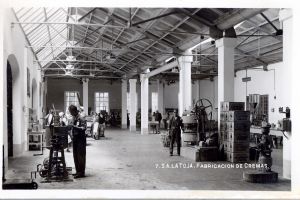
The soap factory during the civil war. Year 1939
Tap the photo to enlarge it
Introduction
The A Toxa soap factory: its unexpected origin
The building opposite you lies where once was the old soap factory of Illa da Toxa.
The building opposite you lies where once was the old soap factory of Illa da Toxa.
Description
The soap was one of the most famous in the national territory, which began to be marketed in 1905 by the La Toja Anonymous Society. What few people know is that its birth was the result of chance. The company thought of making soaps for advertising, like other objects that they sold by exporting the La Toja brand and, as such, they did not constitute a business base in themselves. On the contrary, they would be one more expense, such as almanacs, notebooks, ashtrays, penknives ... Since they did not earn anything from their sale, soaps were made with the purest and most expensive products, saturating them with mineral salts. Each bar of soap had all the salt it could contain, and that resulted in the skin patients who used them to heal. No more was needed. Demand grew, and in 1934 the first expansion of the factory was carried out, followed by successive others. Due to the new demands of the national and international market, production limits of the historic factory were reached, and thus, in view of the physical limitations of the island, a second factory was built in A Coruña in 1965 - located in A Ponte da Pasaxe. -, dependent on the main factory of the island. It was then moved to Culleredo in 1980, and closed in 2007. Today, A Toxa's soaps make a great European journey before reaching our hands, but trailers continue to come to take water to the new production centres.
Audio guides
1.36Mb
Transcript
A Toxa soap factory, its unexpected origin. The former soap factory of Illa da Toxa used to stand on the site of the building in front of you. It was one of the most famous in Spain and was opened in 1905 by the La Toja company. But not many people know that it began as something quite different. The company first intended to make soaps and other items as a way of advertising the La Toja brand, not as a business venture. They were just one of many promotional items, such as almanacs, notebooks, ashtrays, pen knives, and so on. As the soaps were not made for profit, but were rather an expense, they used the purest and most expensive ingredients, and lots of the local mineral water. Every bar of soap was bursting with mineral salts, and people with skin conditions soon found that it had a curative effect. The product was a hit. Demand kept growing, and the factory was enlarged several times, starting in 1934. The soap was so popular in the national and international market that the old factory could not produce enough to meet demand. Space was limited on the island, so in 1965 a second factory was opened in A Coruña, at A Ponte da Pasaxe, dependent on the main factory. In 1980 it was moved to Culleredo and finally closed in 2007. Today, La Toja soaps go on a long journey through Europe before they reach us. But the tanker trucks still come here to collect the water and take it to the new production centres.